 Peggy Whiteneck, Freelance Writer |
|||
In a Violent World, Religion Is Not the Problem- © Peggy WhiteneckIt has become fashionable these days to blame religion for the savage violence in the world at the dawn of the 21st century. But religion is not the problem. The problem isn't even the co-opting of religion by extremists, however evident and pervasive that may be in the modern world. The problem is that moderate and progressive people of faith have ceded the middle ground - the ground of civilization itself - to fanatics, extremists, militants, zealots, fundamentalists (pick your favorite noun to describe today's Grand Inquisitors). It is easy for American secularists to look to the Middle East
for support for their thesis that religion is at the
root of the world's violence. The unending conflict between Israelis and
Palestinians has led much of the rest of the world to a state of exasperated
compassion fatigue toward both sides. Radical Shi'ites and Sunis in Iraq have made
a mockery of any attempt to build a healthy Iraqi state to replace the
dystopia handed them by Bushism. And the Taliban in Afghanistan
is the very poster child for what happens when religious fanatics are
allowed to seize cultural and political dominance. But lest we in the "Christian" West be tempted to feel morally superior to the people of the Middle East, we have only to remember the lingering effects of the fratricidal war between Protestants and Catholics in Northern Ireland. More recently, we have only to look at the impact of the so-called Christian Coalition on national life in the United States - a coalition that gave us Bushism and what is arguably the biggest internal threat to American democracy in the history of the Republic. Clearly, we who ostensibly live at the very heart of the so-called free world are not immune to having our political life and national goals shanghaied by religious zealots. Why Fundamentalism Is Fundamentally UnhealthyThe great British jurist John Fletcher Moulton called ethics "obedience to the unenforceable" - obedience to some higher order, in other words, than law. This is the voluntary realm of morals and manners, where people comply with societal norms not because they are compelled to do so by some external law or authority but because they choose to do so out of some fundamental personal decision about what kind of world they want to live in. In his ethics, Moulton was an Aristotelian. Aristotle saw virtue as that mean point between opposing excesses. The classical example is courage as the mean between cowardice at one extreme and foolhardiness at the other. Similarly, Moulton said that the health of a society can be known by how broad the "middle ground" is between two extremes of absolute regulation at one end and absolute license at the other. In an unhealthy society, he said, the middle ground - what we might call the ground of civilization itself - has been squeezed and narrowed by the pressures and incursions of the polar opposites as they fight each other for control. In the maximally unhealthy society, the "winning" side takes over most or all of the territory of civil and political life. Adapting Moulton's insights, much of the lack of civil health in the world
is traceable not to religion but to the co-opting of religion by militants,
who used to dwell on the fringes but who increasingly occupy the public square
itself. There they hold forth, the antithetical extremes of Christian Rightist
and Islamist Militant, each claiming to speak for God - whether because no one
bothers to contradict them or because no one dares. The nature of religious conflict of this kind is that neither of the warring extremes can control the other. The management of extremism has to come from within the broader religious traditions that extremists presume to represent. Christians must pin the arms of Christian extremists, and Muslims must pin the arms of Islamists, Jews the arms of Zionist fanatics, and so on. As long as religious moderates and progressives continue to shirk that reponsibility, militants will continue drumming their demented tatoo on everyone else's head. How does one exert such control? By standing up on one's own two feet and saying to extremists, loudly and publicly and as often as necessary, "You do not speak for us!" Nothing fuels and emboldens extremism like the silence of the rest of us. The Hallmarks of Religious ExtremismJesus said, "By their fruits you shall know them." Thus, fundamentalism is,
at heart and root and in faith and action, the same the world over, no matter
the particular doctrinal garb it wears nor the particular Scripture to which it lays
claim. Fundamentalists all share three characteristics: passion,
self-righteousness, and intolerance.
Passion could be a virtue if fundamentalism didn't elevate it to an Aristotelian extreme, a kind of warped zeal. There is something in us as humans that wants a healthy dollop of passion in our beliefs and that desperately misses it in the so-called "middle ground." That's why the term "moderate" so often carries with it the resonance of those other M-sounding words, mediocrity and milquetoast. (For this reason, I prefer the term "progressive," rather than "moderate," to describe Moulton's middle ground.) Part of taking religion back from the yahoos, both here in the U.S. and throughout the world, is re-discovering the healthy passion that underlies all genuine faith. With the exception of people like Joan Chittister (the Roman Catholic nun who has made a nonviolent but passionate career of speaking the truth to power, in both Church and world), the lack of passion among religious progressives is the reason mainstream religion is so unattractive to the young, for whom passion is everything. The other two characteristics of radical fundamentalism are self-righteousness and intolerance. These twin handmaids are singularly and jointly dangerous to civil life. Together, they say, "There's only one right way to live, and it's ours." They claim to represent "family values" against the Godless (which is everyone else who isn't them). They declare as anathema any way of life, any belief, that doesn't fit into their own tightly bound little kit bag. The cognitive dissonance wrought by the undeniable existence of beliefs different from theirs quickly tends to a murderous rage. Although the murderous religious impulse ought to be an oxymoron, the ancient paradox that gave us the Inquisition is alive and kicking among 21st century religious militants of every faith: it's not only how we get suicide bombers in Iraq but how we get abortion clinic bombers in the U.S. Taking Back the NightThe real problem, though, is not the bombers, though they get all the publicity. The real problem is the radical sentiment in a somewhat broader, though still minority, population that tacitly supports radical responses to the cognitive dissonance created by other beliefs and values. For such armchair theologians, the kamikaze element in fundamentalism serves as cannon fodder. Thus, it's not uncommon to hear Christian fundamentalists express sympathy, however covertly, with people who assassinate abortion clinic doctors in the name of "right to life." It's also why character assassination is a prime political tactic in the arsenal of the Christian Right in the United States: a murderous impulse is a murderous impulse, even if it's only allowed to express itself metaphorically. Both Islam and Christianity contain in their Scriptures exhortations to go out and make converts of the nations. Well, you don't win the hearts and minds of agnostics and unbelievers with the sword of malevolence. Religion will continue to be seen as a hateful force in the world until progressive people of faith find within themselves the passion to reclaim religion from those who, in the very name of God, distort and abuse it.
· Finding a Voice in an Age of
Intolerance · |

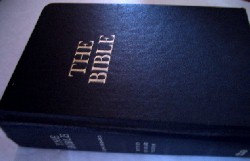 There is no Scripture, whether Bible, Torah, or
Koran, that can't be distorted by those who appoint themselves its most ardent
defenders.
There is no Scripture, whether Bible, Torah, or
Koran, that can't be distorted by those who appoint themselves its most ardent
defenders.


|
The logo banner for this
site was generated at Cool Archive (http://www.coolarchive.com/) and
the side border graphic was provided courtesy of Pambytes (www.pambytes.com).
Special thanks to Monica L. Stewart for the matching logo design. Buttons
at the bottom of the page were texted using graphics provided
courtesy of Button Generator (www.buttongenerator.com). All photographs and
text content on this site are
© Peggy Whiteneck. No reproduction
of any part of this content is permitted
without express permission of the
web site author.